Breast Invasive Carcinoma RNA-seq Data Analysis
Author: Kinza RIAN (kinza.rian@juntadeandalucia.es)
Date: 2024-10-01
Introduction
This notebook outlines the data pre-processing steps performed for the breast cancer study case using the Metabopathia tool. The workflow begins with a Principal Component Analysis (PCA) to assess data quality and establish criteria for selecting clear RNA-seq data for downstream analysis. Following this, gene expression normalization was carried out using the trimmed mean of M-values (TMM) method. After normalization, the data were log-transformed, and truncation was applied at the 99th percentile to manage outliers. To address batch effects, the ComBat method was employed.
The outline is :
- Loading Libraries and sourcing needed files
- Data Acquisition and Preparation
- Metadata Overview and Initial Data Exploration
- Data re-selection
- Filter Lowly Expressed Genes
- Normalization TMM and Log-transformation
- Trunction at the 99th percentile
- Principal component analysis
- Batch effect removal using Combat
- Hierarchical Clustering for Preprocessed Data
- save data for metabopathia
Loading Libraries and sourcing needed files
# Source utils.R file: where functions are pre-definded:
source("utils.R")
# Define packages
cran_packages <- c("ggplot2", "dplyr", "tibble", "data.table", "FactoMineR", "factoextra", "mixOmics", "tidyverse", "see","plotly")# TODO: Here have to pay att with libraries conflicts
bioc_packages <- c("SummarizedExperiment", "SEtools", "edgeR") #EDASeq
# Call the function to install or load packages
check_and_install(cran_packages, bioc_packages, condaEnv = T)
Data Acquisition and Preparation
cancer_type <- "BRCA"
cancer_name <- "Breast invasive carcinoma"
cancer_id <- paste("TCGA", cancer_type, sep = "-")
names(cancer_id) <- cancer_name
cancer_id
As mentioned earlier, this study focuses on RNA-seq data from Breast Invasive Carcinoma. The data were previously downloaded from The Cancer Genome Atlas (TCGA) using a series of shell scripts to automate the process and efficiently handle the large dataset. These scripts were designed to download RNA-seq data for 12 different cancer types as part of a method comparison pipeline. As a result, the scripts are generic and adaptable for any cancer type, allowing one or more datasets to be downloaded by simply adding the needed cancer ID in the command line.
Data download scripts
To facilitate the download, we used a shell script (get_data_in_parallel.sh) that retrieves data for each cancer type in parallel. This was executed using the Slurm workload manager with the following command (retrieved on June 27, 2024):
sbatch --job-name=getData --mem=200000 --error='.err_parallel.job' --output='.out_parallel.job' get_data_in_parallel.sh {BRCA}
sbatch command to submit the job to the Slurm scheduler.
--job-name Option specifies the name of the job as getData for example.
--mem=200000 Allocates 200 GB of memory for the job, depends on available resources in the cluster!
--error and --output: To write error and output logs to specific files (.err_parallel.job and .out_parallel.job).
Script details
get_data_in_parallel.sh: This script initiates the download process in parallel for the specified cancer types. You can find the script at the following link: get_data_in_parallel.sh.
Note: This command may require adaptation depending on the resources available in your computing environment. Adjustments to this command will not affect the reproducibility of this report.
Used Shell scripts
get_data_in_parallel.sh: This script manages the parallel execution of the data retrieval for each cancer type by calling the next script for each specified type.
View on GitHubget_data_per_cancer.sh: This script is called by the parallel script to handle the data download for a single cancer type.
View on GitHubgdc_getData.R: An R script that interacts with the TCGA data portal to fetch the RNA-seq data.
View on GitHub
Data Storage
The downloaded data is organized in a folder named processed_data. Within this folder, there are subfolders for each cancer type containing the following:
- Temporary files generated during the download process.
- The key output file:
counts?<cancerID>.RData, which contains the RNA-seq counts for each cancer type and will be used in subsequent analysis steps.
By organizing the download process in this manner, we ensure that the data acquisition is efficient, reproducible (data retrieved from TCGA portal on June 27, 2024), and easy to manage. This structure allows us to quickly access and process the data for downstream analysis.
my_dir <- "processed_data/"
data <- load_data(cancer_id, my_dir)
brca_count <- assay(x = data,i ='unstranded') %>% as.data.table(keep.rownames = T)
meta_data <- colData(data) %>% data.table::as.data.table() %>% dplyr::select(c(barcode, project_id, sample_type))
#all_metaType in the data
colData(data) %>% data.table::as.data.table() %>% dplyr::select(c('sample_type_id','sample_type','specimen_type','tissue_type')) %>% unique %>% unique
| sample_type_id | sample_type | specimen_type | tissue_type |
|---|---|---|---|
| <chr> | <chr> | <chr> | <chr> |
| 01 | Primary Tumor | Solid Tissue | Tumor |
| 11 | Solid Tissue Normal | Solid Tissue | Normal |
| 06 | Metastatic | Unknown | Tumor |
# Checking if the .rds files already exist before saving them:
check_and_save_RDSs(data=brca_count, metadata=meta_data,
my_dir=my_dir, version="v1",
prefix_countdata_file= "brca_unstranded_counts_data_",
prefix_metadata_file ="brca_counts_metadata_")
Saved: processed_data//brca_unstranded_counts_data_v1.rds Saved: processed_data//brca_counts_metadata_v1.rds
get_object_size()
| Object | Size |
|---|---|
| <chr> | <chr> |
| data | 2596.1 Mb |
| brca_count | 290.2 Mb |
| check_and_install | 0.1 Mb |
| meta_data | 0.1 Mb |
Load previously saved Data (RDS files)
This step is for situations where the counts and metadata have already been saved as RDS files, allowing us to load the existing data and start from there, bypassing the initial steps.
version_of_data <- "v1"
brca_count <- load_RDS_data(name="brca_count",my_dir, version= version_of_data, prefix_file= "brca_unstranded_counts_data_" )
meta_data <- load_RDS_data(name="meta_data",my_dir, version= version_of_data, prefix_file= "brca_counts_metadata_" )
brca_count is already loaded in the environment. meta_data is already loaded in the environment.
The load_RDS_data function checks if the variable is already loaded in the environment before loading it again.
Metadata Overview and Initial Data Exploration
Examination of Participant and Sample Counts in Tumor and Normal Data
dim(brca_count)
- 60660
- 1232
This dataset contains a total of 1231 samples (first column is for gene names).
Next, we will check in the metadata the number of cases or participants, the meta_data contains information about each sample—barcode, project ID, and the type of tissue sample.
In the folowing plot , we can check the number of samples and the number of participants/cases in breast cancer data set:
plot_per_cancer_cases_vs_samples(meta_data)
# A tibble: 3 × 3 sample_type num_samples num_participants <chr> <int> <int> 1 Metastatic 7 7 2 Primary Tumor 1111 1095 3 Solid Tissue Normal 113 113

Summary of Preservation Methods Across Sample Types
preservation_summary <- colData(data)[, c('sample_type', 'preservation_method')] %>%
as_tibble() %>%
group_by(sample_type, preservation_method) %>%
summarise(n = n()) %>%
arrange(preservation_method)
`summarise()` has grouped output by 'sample_type'. You can override using the `.groups` argument.
preservation_summary
| sample_type | preservation_method | n |
|---|---|---|
| <chr> | <chr> | <int> |
| Primary Tumor | FFPE | 16 |
| Metastatic | OCT | 3 |
| Primary Tumor | OCT | 679 |
| Solid Tissue Normal | OCT | 67 |
| Metastatic | Unknown | 4 |
| Primary Tumor | Unknown | 416 |
| Solid Tissue Normal | Unknown | 46 |
plot <- preservation_summary %>%
ggiraphExtra::ggPieDonut(
ggplot2::aes(pies = sample_type, donuts = preservation_method),
interactive = FALSE
) +
ggplot2::labs(title = "Summary of Preservation Methods Across Sample Types") +
theme(plot.title = element_text(size = 24, face = "bold"))
plot %>% change_label(plot = .)

FFPE preservation is exclusively used for Primary Tumor samples, with only 16 samples recorded. Additionally, OCT is predominantly used for Primary Tumor samples (679), while only 3 Metastatic samples are available. Notably, there are significant counts of Primary Tumor (416) and Solid Tissue Normal (46) samples with an Unknown preservation method.
get_object_size()
| Object | Size |
|---|---|
| <chr> | <chr> |
| data | 2596.1 Mb |
| brca_count | 290.2 Mb |
| change_label | 0.1 Mb |
| meta_data | 0.1 Mb |
| plot | 0.1 Mb |
| plot_per_cancer_cases_vs_samples | 0.1 Mb |
| plot_Preservation_Method_Distribution | 0.1 Mb |
| summarize_preservation_methods | 0.1 Mb |
rm(plot,change_label,summarize_preservation_methods,plot_Preservation_Method_Distribution,plot_per_cancer_cases_vs_samples)
# No need for data, will be removed
rm(data)
get_object_size()
| Object | Size |
|---|---|
| <chr> | <chr> |
| brca_count | 290.2 Mb |
| get_object_size | 0.1 Mb |
| meta_data | 0.1 Mb |
Defining batchs and colors
Before proceeding with the analysis, we will define a set of colors for each batch to ensure clarity in visualizations. To accommodate colorblindness, we will use the Okabe-Ito palette, recommended by Okabe & Ito (2008). This palette is the default in base R (version 4.0.0 and later) and is widely recognized for its accessibility and effectiveness in presenting results to a broad audience.
In addition to the Okabe-Ito palette, other colors were carefully selected and tested using the "Let's get color blind" plugin. This tool simulates color deficiency based on the model by Gustavo M. Machado et al. ("A Physiologically-based Model for Simulation of Color Vision Deficiency," IEEE Transactions on Visualization and Computer Graphics, 2009), ensuring accessibility for individuals with color vision deficiencies.
First, let's assign colors for each sample type:
#get batchs, with colors by batch
batchs<- get_batchs(meta_data, cancer_id)
The get_batchs function processes the metadata containing cancer sample information, extracting batch-related details from the sample barcodes, assigning colors based on sample types, tissue sample site and other attributes, and returning a data.table with these enhancements. Check the TCGA Barcode web page for mor information about Barcode Reading.
Here is the schema used for the Creating Barcodes process:
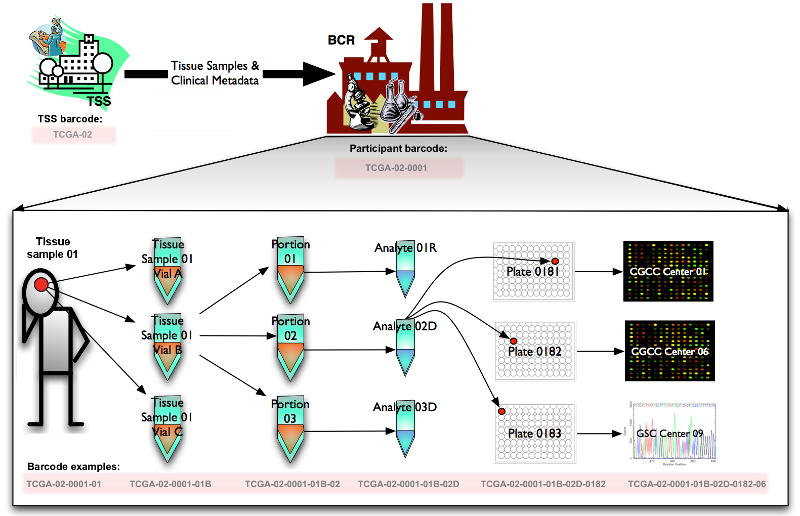
We primarily utilized the following figure to enhance our understanding of barcodes. It clarifies how metadata identifiers are integrated within a barcode and provides guidance on reading these barcodes.
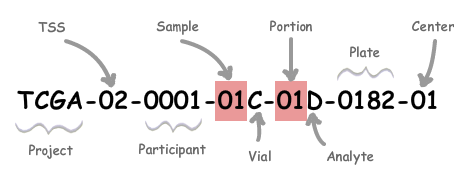
A TCGA barcode is composed of a series of identifiers, each uniquely identifying a TCGA data element.
levels(batchs$center)
According to the GDC TCGA Code Tables, the code 07 corresponds to the following center:
- Center Name: University of North Carolina
- Center Type: CGCC
- Display Name: UNC
levels(batchs$plate) %>% length # by plate: The number of plates is large, making it challenging to create color-blind friendly visuals. A solution needs to be found.
levels(batchs$tss) %>% length
options(repr.plot.width = 20, repr.plot.height = 10) # Adjust width and height as needed
plot_Samples_Cancer(batchs, cancer_names = cancer_name) %>% suppressMessages

⚠️ Important Notice:
The data is imbalanced—the number of Tumor samples is significantly higher than the Normal (or control) samples. This imbalance may affect the analysis and should be carefully considered when interpreting the results.
get_object_size() %>% head
| Object | Size | |
|---|---|---|
| <chr> | <chr> | |
| 1 | countdata_list | 1613.7 Mb |
| 2 | batchs | 2 Mb |
| 3 | metadata_list | 0.7 Mb |
| 4 | get_batchs | 0.2 Mb |
| 5 | change_label | 0.1 Mb |
| 6 | check_and_install | 0.1 Mb |
Data selection
In this section, I will outline the criteria for selecting the data to retain and those to discard. Based on previous analyses of the 12 cancers, we observed significant insights regarding the usage of plates. Notably, 78 out of 178 plates were utilized across multiple cancer types, while 33 out of 45 plates were specifically used for BRCA in conjunction with other cancer types. These findings may guide the data selection process.
The first step in the data selection process involves filtering the dataset to retain only paired data, which consists of 113 samples. This ensures that our analysis focuses on well-matched sample pairs, enhancing the statistical power.
# Filter the data keeping only paired data 113 samples
paired_patients <- batchs %>% dplyr::select(c(participant, groups)) %>% unique() %>% filter(duplicated(participant)) %>% .$participant
paired_patients %>% length
brca_batchs_paired <- batchs %>% filter(participant %in% paired_patients)
brca_batchs_paired %>% filter(participant %in% as.character(brca_batchs_paired %>% filter(sample_type =="Metastatic") %>% .$participant) &
groups =="Tumor") %>% dplyr::select( barcode, sample_type, participant) %>% arrange(participant)
| barcode | sample_type | participant | |
|---|---|---|---|
| <chr> | <fct> | <fct> | |
| TCGA-E2-A15K-01A-11R-A12P-07 | TCGA-E2-A15K-01A-11R-A12P-07 | Primary Tumor | A15K |
| TCGA-E2-A15K-06A-11R-A12P-07 | TCGA-E2-A15K-06A-11R-A12P-07 | Metastatic | A15K |
| TCGA-BH-A18V-01A-11R-A12D-07 | TCGA-BH-A18V-01A-11R-A12D-07 | Primary Tumor | A18V |
| TCGA-BH-A18V-06A-11R-A213-07 | TCGA-BH-A18V-06A-11R-A213-07 | Metastatic | A18V |
| TCGA-BH-A1FE-01A-11R-A13Q-07 | TCGA-BH-A1FE-01A-11R-A13Q-07 | Primary Tumor | A1FE |
| TCGA-BH-A1FE-06A-11R-A213-07 | TCGA-BH-A1FE-06A-11R-A213-07 | Metastatic | A1FE |
As we can see in the table above, the metastatic patients also have samples from the primary tumor. I will remove these samples with a metastatic profile, as they introduce noise in the data (it was showed by a PCA), and there are only three such samples. We will keep other for these patients with primary tumor type
brca_batchs_paired <- brca_batchs_paired %>% filter(sample_type !="Metastatic")
brca_count_paired <- brca_count %>% dplyr::select(all_of(c("rn",brca_batchs_paired$barcode)))
brca_batchs_paired <-droplevels(brca_batchs_paired)
brca_batchs_paired$sample_type %>%table
.
Primary Tumor Solid Tissue Normal
119 113
mypca_brca = mixOmics::pca(t(brca_count_paired[,-1]), ncomp = 5, center = FALSE, scale = FALSE)
plot(mypca_brca)

PC1 captures the majority of variance (>60%), indicating a strong underlying factor influencing the dataset. PC2 explains around 10%, with subsequent components (PC3 and beyond) contributing progressively less. This suggests that most of the variability in the BRCA cancer data can be captured by the first two principal components, while further PCs add minimal additional variance.
p1<-plotIndiv(mypca_brca, comp = 1:2, col.per.group = levels(brca_batchs_paired$c_by_group), ind.names =
FALSE,
group = brca_batchs_paired$groups,
# graphical parameters
style = "ggplot2",
legend = TRUE, legend.position = "right",
legend.title = "Cancer type",
legend.title.pch = 'Sample types',
legend.pch = FALSE, # Show point shape in the legend
ellipse = TRUE,
ellipse.level = 0.95)

The PCA figure illustrates that the raw data for tumor and control groups overlap significantly, indicating a lack of clear differentiation. This suggests that further preprocessing and cleaning of the data are necessary to enhance the visibility of group distinctions and improve the effectiveness of downstream analyses.
p1<-plotIndiv(mypca_brca, comp = 1:2, col.per.group = levels(brca_batchs_paired$c_by_plate),
pch= brca_batchs_paired$groups,
group = brca_batchs_paired$plate,
# graphical parameters
style = "ggplot2",
legend = TRUE, legend.position = "right",
legend.title = "Plates",
legend.title.pch = 'Sample types',
legend.pch = FALSE, # Show point shape in the legend
ellipse = TRUE,
ellipse.level = 0.95)

pca_unscaled_uncenterd_brca_count <- prcomp(t(brca_count_paired[,-1]), scale = F, center = F)
plot_PCAs(as.data.table(pca_unscaled_uncenterd_brca_count$x), brca_batchs_paired)

# Normalization
dge_brca <- do_normalization(brca_count_paired,brca_batchs_paired,method ="TMM", group_col = "sample_type")
# Log-transformation
logCPM_brca <- cpm(dge_brca, log=TRUE)
rownames(logCPM_brca)<- dge_brca$rn
logCPM_brca <- as.data.table(logCPM_brca, keep.rownames = T)
Outliers detection
# Boxplot of Randomly selected gene expression across sample types (Tumor vs Normal)
# (I have changed the seed and run it several time ...)
set.seed(1026) # For reproducibility
selected_genes <- sample(logCPM_brca$rn, 6)
# Reshape for ggplot (convert to long format)
logCPM_brca_long <- melt(logCPM_brca,id.vars = "rn", variable.name = "Sample", value.name = "Expression") %>%
mutate(sample_type= brca_batchs_paired$sample_type[Sample])
ggplot(logCPM_brca_long %>% filter(rn %in% selected_genes) , aes(x = rn, y = Expression, fill = sample_type)) +
geom_boxplot(outlier.colour = "red", outlier.shape = 8, outlier.size = 1) +
labs(title = "Boxplot of Gene Expression Across Sample Types (Tumor vs Normal)",
x = "Gene",
y = "Log-Transformed Expression") +
facet_wrap(~rn, scales = "free_x") + # Divide the plot into Tumor and Normal panels
theme_minimal() +
theme(legend.position = "top",
axis.text.x = element_text(angle = 90, vjust = 0.5, hjust = 1)) # Rotate gene names for readability

Trunction at the 99th percentile: a mild way of reducing outliers impact
Truncation at the 99th percentile can partially address outlier removal, but it’s not strictly considered the same as formal outlier removal. To remove outliers from the data, we can use the Interquartile Range (IQR) method or other approaches to filter out values considered outliers. Typically, outliers are defined as values that are above Q3+1.5×IQRQ3+1.5×IQR or below Q1−1.5×IQRQ1−1.5×IQR, where Q1 and Q3 are the first and third quartiles, respectively, and IQR is the interquartile range (Q3−Q1Q3−Q1).Generaly, outlier removal technics involves completely excluding values that are significantly different from the rest of the data (using statistical methods or visual inspection). In other hand, truncation at the 99th percentile means capping all values above the 99th percentile to the value at the 99th percentile, which reduces the influence of extreme values. It does not remove the data points entirely, but instead limits their impact on further analysis. For this breast cancer data, we will truncate the values at the 99th percentile as a mild way of reducing the impact of extreme values, without treating them as outliers or eliminating them as the IQR method does.
logCPM_brca_99 <- truncate_at_percentile(logCPM_brca[, -1], truncation_percentil = 0.99)
rownames(logCPM_brca_99) <- logCPM_brca$rn
logCPM_brca_99 <- as.data.table(logCPM_brca_99, keep.rownames = T)
# Reshape for ggplot (convert to long format)
logCPM_brca_99_long <- melt(logCPM_brca_99,id.vars = "rn", variable.name = "Sample", value.name = "Expression") %>%
mutate(sample_type= brca_batchs_paired$sample_type[Sample])
# Create a boxplot for the same selected genes divided by sample type after truncation
ggplot(logCPM_brca_99_long %>% filter(rn %in% selected_genes) , aes(x = sample_type, y = Expression, fill = sample_type)) +
geom_boxplot(outlier.shape = NA) + # No outliers displayed in the plot
labs(title = "Boxplot of Selected Genes (6) - Normal vs Tumor (Truncated at 99th Percentile)",
x = "Sample Group",
y = "Log-Transformed CPM") +
theme_minimal() +
theme(legend.position = "none") +
facet_wrap(~ rn) # Separate plots for each gene

pca_unscaled_uncenterd_brca_normalized99 <- prcomp(t(logCPM_brca_99[,-1]), scale = F, center = F)
plot_PCAs(as.data.table(pca_unscaled_uncenterd_brca_normalized99$x), brca_batchs_paired)

The figure shows four PCA plots:
- (A) Colored by plate, with no clear batch effect easily detectable by eye.
- (B) Colored by TSS, showing no clear batch effect, but it can be observed that the 8 outlier samples all come from the same tissue site.
- (C) The PCA plot shows that tumor and control samples are well clustered together, indicating a clear separation between the groups. However, 8 tumor samples were detected as outliers in PC1, positioned far from the main data cluster (above -1000), suggesting potential data anomalies or batch effects that may require further investigation.
wiered_samples <- rownames(pca_unscaled_uncenterd_brca_normalized99$x)[which(pca_unscaled_uncenterd_brca_normalized99$x[,1] > (-1000))]
wiered_samples
- 'TCGA-A7-A13E-01B-06R-A277-07'
- 'TCGA-A7-A13E-01A-11R-A277-07'
- 'TCGA-A7-A0DB-01A-11R-A277-07'
- 'TCGA-A7-A0DB-01C-02R-A277-07'
- 'TCGA-A7-A13G-01A-11R-A13Q-07'
- 'TCGA-A7-A13G-01B-04R-A22O-07'
- 'TCGA-A7-A0DC-01B-04R-A22O-07'
- 'TCGA-A7-A0DC-01A-11R-A00Z-07'
# lets check their behavior in the normalized data
logCPM_brca %>% dplyr::select(all_of(wiered_samples)) %>% head
| TCGA-A7-A13E-01B-06R-A277-07 | TCGA-A7-A13E-01A-11R-A277-07 | TCGA-A7-A0DB-01A-11R-A277-07 | TCGA-A7-A0DB-01C-02R-A277-07 | TCGA-A7-A13G-01A-11R-A13Q-07 | TCGA-A7-A13G-01B-04R-A22O-07 | TCGA-A7-A0DC-01B-04R-A22O-07 | TCGA-A7-A0DC-01A-11R-A00Z-07 |
|---|---|---|---|---|---|---|---|
| <dbl> | <dbl> | <dbl> | <dbl> | <dbl> | <dbl> | <dbl> | <dbl> |
| 4.699873 | 5.0921496 | 5.7039145 | 4.5904405 | 5.591442 | 3.93900229 | 3.807059 | 6.014709 |
| -1.101221 | -0.7961921 | 0.1991546 | -0.2220211 | -1.376363 | -0.06550389 | -1.853107 | -1.966826 |
| 4.189540 | 5.4159087 | 4.7442972 | 3.2622698 | 4.421612 | 3.05446263 | 3.837242 | 5.584697 |
| 4.332984 | 5.1623523 | 5.3688905 | 5.0701664 | 6.247269 | 5.67310459 | 4.282318 | 4.735253 |
| 3.862453 | 4.3591536 | 4.0085753 | 3.9825512 | 4.201083 | 3.51975195 | 2.733943 | 3.650863 |
| 1.416184 | 1.7480988 | 4.3290317 | 1.2218983 | 1.490362 | 2.16044596 | 2.170087 | 0.718840 |
# Create a boxplot for the same selected genes divided by sample type after truncation
ggplot(logCPM_brca_99_long %>% filter(rn %in% selected_genes & sample_type == "Primary Tumor") %>% mutate(weird = Sample %in% wiered_samples) ,
aes(x = sample_type, y = Expression, fill = weird)) +
geom_boxplot(outlier.shape = NA) + # No outliers displayed in the plot
labs(title = "Boxplot of randomly Selected Genes (6) - weird Tumor vs Tumor (Truncated at 99th Percentile)",
x = "Sample Group",
y = "Log-Transformed CPM") +
theme_minimal() +
facet_wrap(~ rn) # Separate plots for each gene

⚠️ Note: We have noticed earlier that some samples are duplicated. Let's revisit and check if there is an intersection between the duplicated tumor samples and these weird tumor samples.
brca_batchs_paired %>% filter(groups =="Tumor" ) %>%
filter(duplicated(participant)| duplicated(participant,fromLast = T)) %>% arrange(participant) %>% .$participant %>% unique
- A0DB
- A0DC
- A13E
- A13G
Levels:
- 'A0AU'
- 'A0AY'
- 'A0AZ'
- 'A0B3'
- 'A0B5'
- 'A0B7'
- 'A0B8'
- 'A0BA'
- 'A0BC'
- 'A0BJ'
- 'A0BM'
- 'A0BQ'
- 'A0BS'
- 'A0BT'
- 'A0BV'
- 'A0BW'
- 'A0BZ'
- 'A0C0'
- 'A0C3'
- 'A0CE'
- 'A0CH'
- 'A0D9'
- 'A0DB'
- 'A0DC'
- 'A0DD'
- 'A0DG'
- 'A0DH'
- 'A0DK'
- 'A0DL'
- 'A0DO'
- 'A0DP'
- 'A0DQ'
- 'A0DT'
- 'A0DV'
- 'A0DZ'
- 'A0E0'
- 'A0E1'
- 'A0H5'
- 'A0H7'
- 'A0H9'
- 'A0HA'
- 'A0HK'
- 'A13E'
- 'A13F'
- 'A13G'
- 'A153'
- 'A158'
- 'A15I'
- 'A15K'
- 'A15M'
- 'A18J'
- 'A18K'
- 'A18L'
- 'A18M'
- 'A18N'
- 'A18P'
- 'A18Q'
- 'A18R'
- 'A18S'
- 'A18U'
- 'A18V'
- 'A1BC'
- 'A1EN'
- 'A1EO'
- 'A1ET'
- 'A1EU'
- 'A1EV'
- 'A1EW'
- 'A1F0'
- 'A1F2'
- 'A1F6'
- 'A1F8'
- 'A1FB'
- 'A1FC'
- 'A1FD'
- 'A1FE'
- 'A1FG'
- 'A1FH'
- 'A1FJ'
- 'A1FM'
- 'A1FN'
- 'A1FR'
- 'A1FU'
- 'A1IG'
- 'A1L7'
- 'A1LB'
- 'A1LH'
- 'A1LS'
- 'A1N4'
- 'A1N5'
- 'A1N6'
- 'A1N9'
- 'A1NA'
- 'A1ND'
- 'A1NF'
- 'A1NG'
- 'A1R7'
- 'A1RB'
- 'A1RC'
- 'A1RD'
- 'A1RF'
- 'A1RH'
- 'A1RI'
- 'A203'
- 'A204'
- 'A208'
- 'A209'
- 'A23H'
- 'A2C8'
- 'A2C9'
- 'A2FB'
- 'A2FF'
- 'A2FM'
wiered_participants <-brca_batchs_paired %>% filter(barcode %in% wiered_samples) %>% arrange(participant) %>% .$participant %>% unique
wiered_participants
- A0DB
- A0DC
- A13E
- A13G
Levels:
- 'A0AU'
- 'A0AY'
- 'A0AZ'
- 'A0B3'
- 'A0B5'
- 'A0B7'
- 'A0B8'
- 'A0BA'
- 'A0BC'
- 'A0BJ'
- 'A0BM'
- 'A0BQ'
- 'A0BS'
- 'A0BT'
- 'A0BV'
- 'A0BW'
- 'A0BZ'
- 'A0C0'
- 'A0C3'
- 'A0CE'
- 'A0CH'
- 'A0D9'
- 'A0DB'
- 'A0DC'
- 'A0DD'
- 'A0DG'
- 'A0DH'
- 'A0DK'
- 'A0DL'
- 'A0DO'
- 'A0DP'
- 'A0DQ'
- 'A0DT'
- 'A0DV'
- 'A0DZ'
- 'A0E0'
- 'A0E1'
- 'A0H5'
- 'A0H7'
- 'A0H9'
- 'A0HA'
- 'A0HK'
- 'A13E'
- 'A13F'
- 'A13G'
- 'A153'
- 'A158'
- 'A15I'
- 'A15K'
- 'A15M'
- 'A18J'
- 'A18K'
- 'A18L'
- 'A18M'
- 'A18N'
- 'A18P'
- 'A18Q'
- 'A18R'
- 'A18S'
- 'A18U'
- 'A18V'
- 'A1BC'
- 'A1EN'
- 'A1EO'
- 'A1ET'
- 'A1EU'
- 'A1EV'
- 'A1EW'
- 'A1F0'
- 'A1F2'
- 'A1F6'
- 'A1F8'
- 'A1FB'
- 'A1FC'
- 'A1FD'
- 'A1FE'
- 'A1FG'
- 'A1FH'
- 'A1FJ'
- 'A1FM'
- 'A1FN'
- 'A1FR'
- 'A1FU'
- 'A1IG'
- 'A1L7'
- 'A1LB'
- 'A1LH'
- 'A1LS'
- 'A1N4'
- 'A1N5'
- 'A1N6'
- 'A1N9'
- 'A1NA'
- 'A1ND'
- 'A1NF'
- 'A1NG'
- 'A1R7'
- 'A1RB'
- 'A1RC'
- 'A1RD'
- 'A1RF'
- 'A1RH'
- 'A1RI'
- 'A203'
- 'A204'
- 'A208'
- 'A209'
- 'A23H'
- 'A2C8'
- 'A2C9'
- 'A2FB'
- 'A2FF'
- 'A2FM'
We can clearly see that these weird samples come from participants who provided two or more samples from the same tumor tissue sites.
brca_batchs_paired$tss %>% table
. A7 AC BH E2 E9 GI 22 8 146 22 30 4
The comun thing between these samples that are coming from A7 tss , according to TCGA is Christiana Healthcare source site and from the study named "Breast invasive carcinoma", with a BCR: NCH.
Hypothesis about these samples: The issue may be with these specific participants, and we might need to remove their corresponding control samples as well. Could this be due to a potential batch effect? Let’s take a closer look at these participants.
brca_batchs_paired %>%filter(participant %in% (brca_batchs_paired %>% filter(barcode %in% wiered_samples) %>% .$participant %>% unique)) %>%
arrange(plate, participant,sampleVial,portionAnalyte )%>% mutate(weird = barcode %in% wiered_samples) %>% dplyr::select(participant, sampleVial,portionAnalyte,plate, groups, weird)
| participant | sampleVial | portionAnalyte | plate | groups | weird | |
|---|---|---|---|---|---|---|
| <fct> | <fct> | <fct> | <fct> | <fct> | <lgl> | |
| TCGA-A7-A0DB-01A-11R-A00Z-07 | A0DB | 01A | 11R | A00Z | Tumor | FALSE |
| TCGA-A7-A0DC-01A-11R-A00Z-07 | A0DC | 01A | 11R | A00Z | Tumor | TRUE |
| TCGA-A7-A0DB-11A-33R-A089-07 | A0DB | 11A | 33R | A089 | Normal | FALSE |
| TCGA-A7-A0DC-11A-41R-A089-07 | A0DC | 11A | 41R | A089 | Normal | FALSE |
| TCGA-A7-A13E-01A-11R-A12P-07 | A13E | 01A | 11R | A12P | Tumor | FALSE |
| TCGA-A7-A13E-11A-61R-A12P-07 | A13E | 11A | 61R | A12P | Normal | FALSE |
| TCGA-A7-A13G-01A-11R-A13Q-07 | A13G | 01A | 11R | A13Q | Tumor | TRUE |
| TCGA-A7-A13G-11A-51R-A13Q-07 | A13G | 11A | 51R | A13Q | Normal | FALSE |
| TCGA-A7-A0DC-01B-04R-A22O-07 | A0DC | 01B | 04R | A22O | Tumor | TRUE |
| TCGA-A7-A13G-01B-04R-A22O-07 | A13G | 01B | 04R | A22O | Tumor | TRUE |
| TCGA-A7-A0DB-01A-11R-A277-07 | A0DB | 01A | 11R | A277 | Tumor | TRUE |
| TCGA-A7-A0DB-01C-02R-A277-07 | A0DB | 01C | 02R | A277 | Tumor | TRUE |
| TCGA-A7-A13E-01A-11R-A277-07 | A13E | 01A | 11R | A277 | Tumor | TRUE |
| TCGA-A7-A13E-01B-06R-A277-07 | A13E | 01B | 06R | A277 | Tumor | TRUE |
Possible Problems with outlier samples captured by PCA
The issue likely stems from batch effects or technical variability associated with specific experimental conditions. All the "weird" samples (marked as TRUE) share common features, such as being processed on the same plates (A277, A22O, A13Q). This suggests that the plate or sample processing conditions may have introduced systematic differences that cause these samples to cluster separately in PCA analysis.
- The problem is likely technical artifacts or batch effects tied to specific plates or conditions rather than biological differences.
- Addressing this may involve batch correction methods (e.g., COMBAT) or removing these samples if they cannot be corrected adequately.
brca_batchs_paired %>% arrange(plate) %>% .$plate %>%table
. A00Z A056 A084 A089 A115 A12D A12P A137 A13Q A144 A14D A14M A157 A169 A16F A17B 7 14 3 22 10 32 30 14 30 12 10 6 18 6 2 4 A19E A19W A21T A22O A277 A466 1 2 2 2 4 1
Plates 277, A22O have only these wiered samples!
In our previous data analysis of the 12 cancers, we observed that the "A22O" plate was exclusively used in the BRCA project.
Data re-selection
Considering that these samples are causing significant noise in our data, we have decided to remove the data from these 4 patients. This decision is based on the need to minimize the impact of these outliers and reanalyze the study.
wiered_participants %>% as.character
- 'A0DB'
- 'A0DC'
- 'A13E'
- 'A13G'
After removing these participants, the dataset will consist of:
- Primary Tumor: 109
- Solid Tissue Normal: 109
brca_batchs_paired %>% filter(!participant %in% wiered_participants) %>% .$sample_type %>% table
.
Primary Tumor Solid Tissue Normal
109 109
brca_batchs_paired <- brca_batchs_paired %>% filter(!participant %in% wiered_participants)
brca_batchs_paired <-droplevels(brca_batchs_paired)
brca_count_paired <- brca_count %>% dplyr::select(all_of(c("rn",brca_batchs_paired$barcode)))
dim(brca_count_paired[,-1])
- 60660
- 218
dim(brca_batchs_paired)
- 218
- 15
pca_unscaled_uncenterd_brca_count_paired <- prcomp(t(brca_count_paired[,-1]), scale = F, center = F)
plot_PCAs(as.data.table(pca_unscaled_uncenterd_brca_count_paired$x), brca_batchs_paired)

Filter Lowly Expressed Genes (adapted to our Pathway Activity analysis approache)
In this analysis, filtering out lowly expressed genes has been adapted. Unlike differential expression analysis pipelines, where removing such genes is common, the mechanistic modeling approach utilized here requires the retention of all available data. If lowly expressed genes were excluded, the method would artificially impute missing values (e.g., using 0.5 or another value), which woucommon_genesEdgeRld not accurately represent the biological reality of low expression. Retaining these genes ensures that the model reflects true biological conditions.
# TODO :
#- Get metabolized genes ! as well
#-enhance the venn diagram : only 1 for three of them
#Get hipathia Ensemble genes
hipathia_genes_table <- get_hipathia_ens_genes()
hipathia_genes<-hipathia_genes_table$ensembl_gene_id_version %>% unique
#identify low Expressed genes
genes0<-rowSums(brca_count_paired[,-1])
genes0<-which( genes0 ==0) %>% brca_count_paired[.,1] %>% .$rn
# tradutiona rowSums Vs sofstiucated filterByExpr: TODO: compare the effect of using filterByExpr
agreedOnRemoving <- filterByExpr(DGEList(brca_count_paired[,-1]),
design = ifelse(meta_data$sample_type == "Solid Tissue Normal" ,1,0),
min.total.count = 1, min.count = 1)
agreedOnRemoving <-brca_count_paired[which(agreedOnRemoving ==0),rn]
setdiff(genes0,agreedOnRemoving) # all genes 0 are in genes captured with filterByExpr()
# Find common and unique genes: agreedOnRemoving
common_genesEdgeR <- intersect(hipathia_genes, agreedOnRemoving)
only_in_hipathiaEdgeR <- setdiff(hipathia_genes, agreedOnRemoving) ## Here I have to save it somewhere to recheck again !
only_in_genes0EdgeR <- setdiff(agreedOnRemoving, hipathia_genes)
suppressMessages(do_venn_diagram(hipathia_genes, agreedOnRemoving)) %>% grid.draw(.)

# Find common and unique genes: genes0
common_genes <- intersect(hipathia_genes, genes0)
only_in_hipathia <- setdiff(hipathia_genes, genes0) ## Here I have to save it somewhere to recheck again !
only_in_genes0 <- setdiff(genes0, hipathia_genes)
suppressMessages(do_venn_diagram(hipathia_genes, genes0)) %>% grid.draw(.)

Great! The intersection between the lowly expressed genes across all cancers and Hipathia is 6 genes using the truditional methods and 294 genes , so we can safely remove the other 28208 genes out of 60660 genes, that have are considered genes lowly expresed between two groups.
hipathia_null_genes_table<-hipathia_genes_table %>% filter(ensembl_gene_id_version %in% common_genesEdgeR)
These genes will be saved to be tracked in the downstream analysis, allowing for more accurate results.
write.table(x = hipathia_null_genes_table, file = file.path(my_dir, paste0("brca_hipathia_null_genes_",version_of_data,".tsv")), sep = "\t", quote = F,row.names = F, col.names = T)
brca_count_paired <- brca_count_paired %>% filter(!rn %in% only_in_genes0EdgeR)
Principal component aalysis after low count filtering:
pca_unscaled_uncenterd_brca_count_paired <- prcomp(t(brca_count_paired[,-1]), scale = F, center = F)
plot_PCAs(as.data.table(pca_unscaled_uncenterd_brca_count_paired$x), brca_batchs_paired)

rm(hipathia_null_genes_table, hipathia_genes_table,only_in_hipathia, only_in_genes0, hipathia_genes, do_venn_diagram, genes0,get_info_counts)
get_object_size()%>%head
| Object | Size | |
|---|---|---|
| <chr> | <chr> | |
| 1 | logCPM_brca_99_long | 326.8 Mb |
| 2 | logCPM_brca_long | 326.8 Mb |
| 3 | brca_count | 290.2 Mb |
| 4 | logCPM_brca | 112.5 Mb |
| 5 | logCPM_brca_99 | 112.5 Mb |
| 6 | pca_unscaled_uncenterd_brca_count | 107.8 Mb |
Normalization TMM and Log-transformation
# Normalization
dge_brca <- do_normalization(brca_count_paired,brca_batchs_paired,method ="TMM", group_col = "sample_type")
# Log-transformation
logCPM_brca <- cpm(dge_brca, log=TRUE)
rownames(logCPM_brca)<- dge_brca$rn
logCPM_brca <- as.data.table(logCPM_brca, keep.rownames = T)
Trunction at the 99th percentile
logCPM_brca_99 <- truncate_at_percentile(logCPM_brca[, -1], truncation_percentil = 0.99)
rownames(logCPM_brca_99) <- logCPM_brca$rn
logCPM_brca_99 <- as.data.table(logCPM_brca_99, keep.rownames = T)
# Reshape for ggplot (convert to long format)
logCPM_brca_99_long <- melt(logCPM_brca_99,id.vars = "rn", variable.name = "Sample", value.name = "Expression") %>%
mutate(sample_type= brca_batchs_paired$sample_type[Sample])
# Create a boxplot for the same selected genes divided by sample type after truncation
ggplot(logCPM_brca_99_long %>% filter(rn %in% selected_genes) , aes(x = sample_type, y = Expression, fill = sample_type)) +
geom_boxplot(outlier.shape = NA) + # No outliers displayed in the plot
labs(title = "Boxplot of Selected Genes (6) - Normal vs Tumor (Truncated at 99th Percentile)",
x = "Sample Group",
y = "Log-Transformed CPM") +
theme_minimal() +
theme(legend.position = "none") +
facet_wrap(~ rn) # Separate plots for each gene

Principal component analysis
pca_unscaled_uncenterd_brca_normalized99 <- prcomp(t(logCPM_brca_99[,-1]), scale = F, center = F)
plot_PCAs(as.data.table(pca_unscaled_uncenterd_brca_normalized99$x), brca_batchs_paired)

res.pca.brca <- PCA(t(logCPM_brca_99[,-1]), graph = FALSE, ncp = 4, scale.unit = F)
fviz_pca_ind(res.pca.brca, geom = "point", pointsize = 3, addEllipses = T,
col.ind = brca_batchs_paired$sample_type)

fviz_pca_ind(res.pca.brca, geom = "point", pointsize = 3, addEllipses =F, ellipse.level=0.95, fill.ind = brca_batchs_paired$sample_type,
col.ind = brca_batchs_paired$plate)

fviz_pca_ind(res.pca.brca, geom = "point", pointsize = 3, addEllipses =F, ellipse.level=0.95, fill.ind = brca_batchs_paired$sample_type,
col.ind = brca_batchs_paired$tss)

# batch effect if there is : I dont concider that they are batch effect to remove ! but let have a look if data get better
Batch effect removal using Combat
my_mod_brca <-model.matrix(~as.factor(groups), data=brca_batchs_paired)
# Apply ComBat for plate BE
brca_combat4plate <- sva::ComBat(dat = logCPM_brca_99[,-1],
mod = my_mod_brca,
batch = brca_batchs_paired$plate,
par.prior = TRUE,
prior.plots = FALSE)
Found 2538 genes with uniform expression within a single batch (all zeros); these will not be adjusted for batch.
Using the 'mean only' version of ComBat Found20batches Note: one batch has only one sample, setting mean.only=TRUE Adjusting for1covariate(s) or covariate level(s) Standardizing Data across genes Fitting L/S model and finding priors Finding parametric adjustments Adjusting the Data
rownames(brca_combat4plate)<-logCPM_brca_99$rn
brca_combat4plate<-as.data.table(brca_combat4plate, keep.rownames = T)
pca_unscaled_uncenterd_brca_combat4plate <- prcomp(t(brca_combat4plate[,-1]), scale = F, center = F)
plot_PCAs(as.data.table(pca_unscaled_uncenterd_brca_combat4plate$x), brca_batchs_paired)

res.pca.brca.combat <- PCA(t(brca_combat4plate[,-1]), graph = FALSE, ncp = 4, scale.unit = F)
fviz_pca_ind(res.pca.brca.combat, geom = "point", pointsize = 3, addEllipses = T,
col.ind = brca_batchs_paired$sample_type)

mypca_brca_combat = mixOmics::pca(t(brca_combat4plate[,-1]), ncomp = 5, center = FALSE, scale = FALSE)
plot(mypca_brca_combat)
plotIndiv(mypca_brca_combat, comp = 1:2, col.per.group = levels(brca_batchs_paired$c_by_group), ind.names =
FALSE,
group = brca_batchs_paired$groups,
# graphical parameters
style = "ggplot2",
legend = TRUE, legend.position = "right",
legend.title = "Cancer type",
legend.title.pch = 'Sample types',
legend.pch = FALSE, # Show point shape in the legend
ellipse = TRUE,
ellipse.level = 0.95)


The PCA plot shows that PC1 explains 94% of the variance in the data, indicating that the first principal component captures most of the variability. This suggests that the major source of variation in our dataset is well represented by PC1, potentially reflecting a key biological or technical factor in the data.
pca_plotly(pca_unscaled_uncenterd_brca_combat4plate, brca_batchs_paired)
#TODO PLS, heat maps ...
Hierarchical Clustering for Preprocessed Data
In this step, hierarchical clustering (H-clustering) is performed to assess the quality of data by observing how well the samples cluster together. Proper clustering can indicate that the data is well-structured and suitable for downstream analyses.
options(repr.plot.width = 15, repr.plot.height = 15)
par(mar = c(0, 0, 0, 0))
plot(as.phylo(hclust(dist(t(brca_combat4plate[,-1])), "ward.D")),
type = "fan",
tip.color = levels(brca_batchs_paired$c_by_group)[cutree(hc, 2)],
label.offset = 1,
cex =0.9)

Note: Samples were classified exactly according to the real experimental design.
source("utils.R")
p<-do_hc(brca_combat4plate, brca_batchs_paired)
embed_notebook(p) # Feel free to zoom-in and zoom-out ; it's a plotly :)
The clustering dendrogram visualizes the relationships between samples, and I've colored the branches based on the classification group. Additionally, I'm using Plotly to make the graph interactive, allowing for easier exploration of sample clustering patterns and helping to visually distinguish between tumor and control samples.
save data for metabopathia
# Final Check : if the meta data and Gene expression data has the same samples:
all(colnames(brca_combat4plate[,-1]) %in% brca_batchs_paired$barcode) # are all in ?
dim(brca_combat4plate[,-1])
- 32452
- 218
brca_batchs_paired$groups %>% table
. Normal Tumor 109 109
fwrite(x = brca_combat4plate, file = file.path(my_dir, paste0("BRCA_109Nx109T_paired_normalized_trun99_combat_data_", version_of_data,".tsv")),
quote = F, append = F, sep = "\t",
row.names = F, col.names = T, verbose = F)
fwrite(x = brca_batchs_paired, file = file.path(my_dir, paste0("BRCA_109Nx109T_paired_metadata_", version_of_data,".tsv")),
quote = F, append = F, sep = "\t",
row.names = F, col.names = T, verbose = F)
# The end !
#TODO: Pathway enrichment analysis